Blog
Graviron Aerospace Enters Partnership & Co-Development Agreement with xOrbita to Advance Autonomous Orbital Operations

September 15, 2026
Graviron Aerospace, Inc. has entered into a Partnership and Co-Development Agreement with xOrbita Inc. to advance spacecraft autonomy, maneuver planning, and navigation capabilities relevant to the development of its Orbit Keeper satellite program.
The collaboration brings together Graviron’s spacecraft development efforts and xOrbita’s work on autonomous spacecraft maneuver planning and guidance, navigation, and control (GNC) optimization. xOrbita’s ARBITER software focuses on rendezvous and proximity operations (RPO) and collision-avoidance maneuvers.
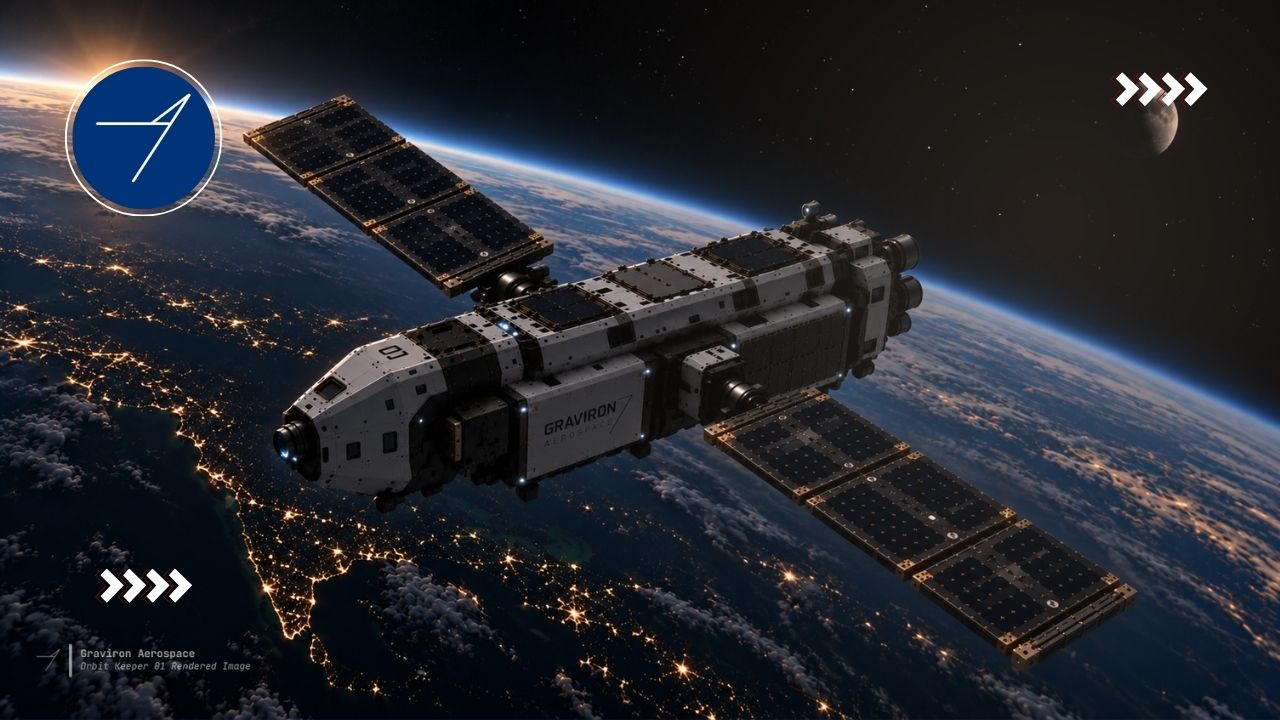
Graviron is developing Orbit Keeper, a standardized satellite program for building distributed data centers in orbit. As the company works toward deploying its orbital computing infrastructure, spacecraft autonomy, navigation, and maneuver planning are important engineering considerations for reliable spacecraft operations.
Advancing Spacecraft Autonomy
Spacecraft operate in a dynamic orbital environment where trajectories, propulsion constraints, operating conditions, and surrounding objects influence mission planning and spacecraft operations.
Autonomous spacecraft technologies can support the evaluation of maneuver options, account for mission constraints, and assist in determining how and when a spacecraft should adjust its trajectory.
Through the agreement, Graviron and xOrbita established a framework for collaboration on autonomy and navigation technologies relevant to Orbit Keeper. The work includes areas such as maneuver planning, relative navigation, target tracking, rendezvous and proximity operations planning, and autonomous decision support.
These capabilities are relevant to spacecraft control and the planning of orbital maneuvers. Their implementation depends on the spacecraft architecture, available navigation data, propulsion capabilities, and mission-specific requirements.
Maneuver Planning and Collision Avoidance
Maneuver planning is an important part of spacecraft operations. A spacecraft must account for its orbital trajectory, available propulsion resources, and mission objectives when evaluating potential maneuvers.
Collision avoidance adds another consideration: assessing potential close approaches and determining whether an adjustment to the spacecraft’s trajectory is necessary.
xOrbita develops software intended to optimize spacecraft maneuvers for collision avoidance and rendezvous and proximity operations, including approaches designed to reduce propellant requirements while accounting for mission constraints.
For Orbit Keeper, these technologies are relevant to the wider spacecraft-control and mission-planning architecture. Maneuver planning must consider orbital conditions, propulsion availability, timing, and the safety of the spacecraft and other orbital assets.
The collaboration provides a framework for developing and integrating relevant software and navigation capabilities into the broader spacecraft architecture.
Collaboration and Technical Responsibilities
Under the agreement, Graviron retains responsibility for the Orbit Keeper spacecraft, propulsion, vehicle-level flight control, and spacecraft systems. xOrbita contributes technologies related to maneuver planning, relative navigation, target detection and tracking, and autonomous mission planning.
The companies’ engineering teams will establish detailed technical requirements and integration criteria as the collaboration progresses.
Graviron will retain final vehicle-level safety and flight-control authority, with external autonomy capabilities operating within the spacecraft’s broader control and safety architecture.
This collaboration allows spacecraft autonomy and maneuver planning to be addressed as a dedicated engineering workstream within the Orbit Keeper development program.
Supporting Orbit Keeper 01 Development
Graviron’s immediate spacecraft priority is Orbit Keeper 01 Vector, the initial configuration in its standardized satellite program.
The spacecraft is being developed to provide onboard computing capacity for AI and other compute-intensive workloads in Low Earth Orbit (LEO), with accommodation for compatible customer payloads as an additional capability.
Its first commercial mission is targeted for Q2 2028 and is intended to carry customer payloads alongside Graviron’s onboard orbital-computing capability.
Spacecraft autonomy, navigation, and maneuver planning are among the engineering considerations involved in preparing a spacecraft for orbital operations. The xOrbita collaboration contributes to this area of development as Graviron continues advancing Orbit Keeper 01 Vector.
Beginning in late 2028, Graviron plans to focus on fleet development, building on the engineering findings and operational experience gained from its initial mission.
About xOrbita
xOrbita Inc. develops spacecraft autonomy and maneuver-planning software, including capabilities for rendezvous and proximity operations and collision avoidance.
About Graviron Aerospace
Graviron Aerospace is developing distributed data centers in orbit through its standardized Orbit Keeper satellite program. The company is focused on building orbital computing capacity for AI and other compute-intensive workloads in Low Earth Orbit, with hosted payload accommodation as an additional capability.
Its first commercial mission, Orbit Keeper 01 Vector, is targeted for Q2 2028, followed by a planned focus on fleet development from late 2028.
Graviron Aerospace, Inc.