Blog
Reusable Orbital Drones: A New Approach to Post-Launch Space Operations

Getting a spacecraft into orbit is only the beginning.
Once a satellite is deployed, changing its orbit, inspecting its condition, servicing it, or responding to an unexpected problem can become extremely difficult. The spacecraft may be hundreds of kilometers above Earth, travelling at several kilometers per second, and designed around a specific mission with limited ability to interact with other objects.
The space industry has developed technologies to address parts of this challenge. Space tugs can move spacecraft between orbits. Servicing vehicles can rendezvous with and interact with satellites. Reusable spaceplanes can operate in orbit and return to Earth. Autonomous navigation systems are making increasingly complex proximity operations possible.
But an important question remains:
What if an orbital vehicle were designed from the beginning to perform repeated missions using a common, reusable vehicle architecture?
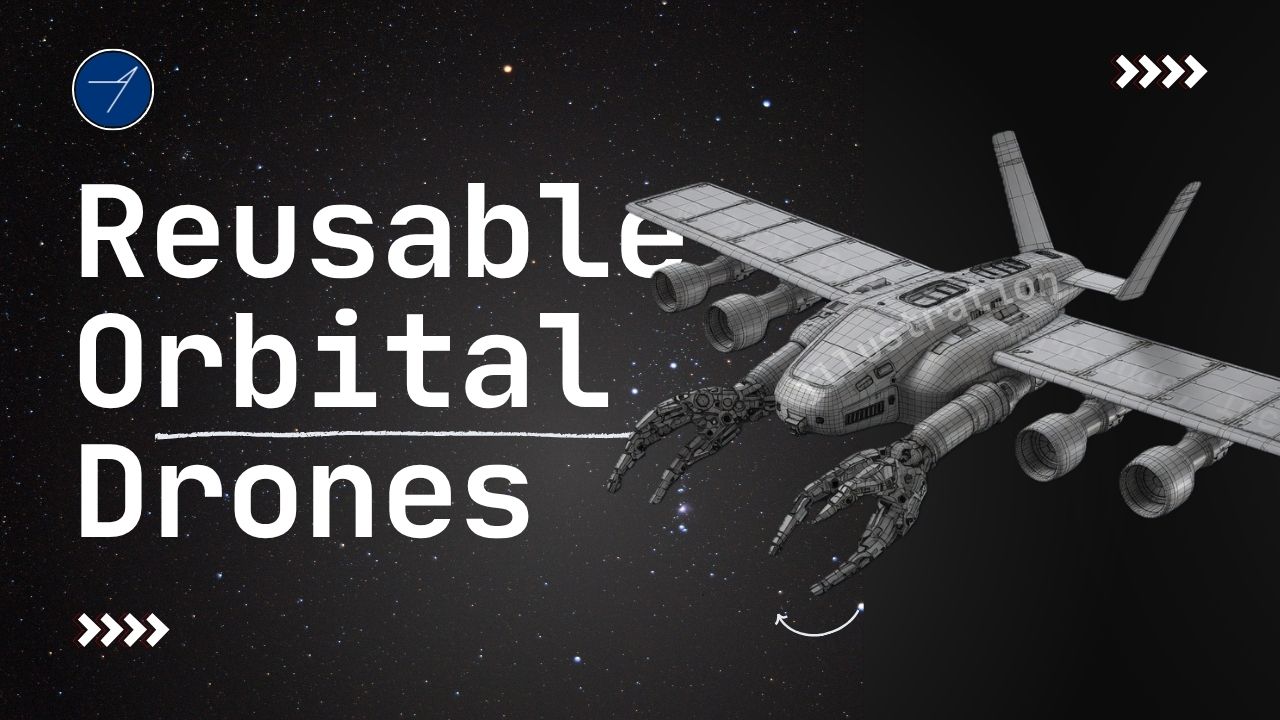
That is the idea behind the Reusable Orbital Drone (ROD).
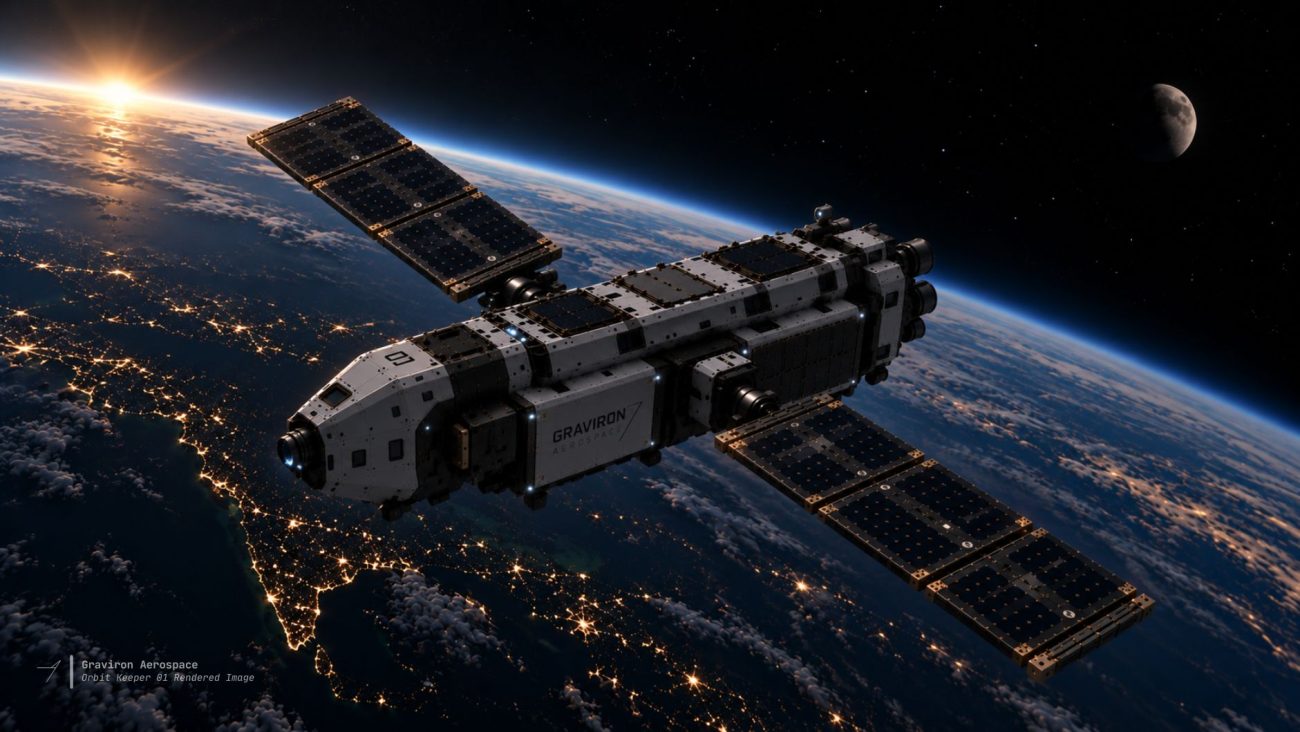
At Graviron Aerospace, we view this as a long-term vehicle-development direction. Our current commercial focus is Orbit Keeper 01, which is being developed for hosted payloads and orbital computing. The Reusable Orbital Drone concept represents a broader technical ambition for future vehicle configurations, rather than a description of what Orbit Keeper 01 is designed to do.
The post-launch problem
Most spacecraft are designed around a particular mission.
A satellite is launched, deployed into its operational orbit, and then spends most of its useful life performing the function it was designed for. If its requirements change after launch, the available options may be limited.
Depending on the spacecraft and mission, future orbital operations could involve:
- Moving a spacecraft to a different orbit.
- Inspecting an asset after an anomaly.
- Transporting a payload between orbital locations.
- Supporting a spacecraft that requires assistance.
- Managing a spacecraft at the end of its operational life.
Historically, many of these activities have required dedicated vehicles or specialized mission architectures.
This creates an engineering challenge: the orbital environment is becoming more active, while many spacecraft remain designed primarily to perform their own individual missions.
The industry is developing the technologies needed for more active operations in orbit. The European Space Agency’s In-Space Proof-of-Concepts programme, for example, addresses rendezvous and docking, refuelling, onboard intelligence, and advanced space logistics.
The question is how these capabilities might be combined into vehicle architectures designed for repeated orbital work.
From spacecraft to orbital infrastructure
One approach is to separate the vehicle from the mission.
Instead of designing an entirely new spacecraft around every individual task, a reusable vehicle could retain a common core while supporting different mission configurations over its operational lifetime.
The same vehicle might perform one mission, undergo inspection and refurbishment, and later be assigned another mission—provided its design, remaining life, and operational constraints permit it.
This changes the way the vehicle is considered economically. Rather than treating it as hardware dedicated to a single mission, the vehicle becomes an asset intended for repeated utilization.
The concept does not replace satellites or eliminate the need for specialized spacecraft. It adds another possible layer to the orbital ecosystem: vehicles designed to perform work for other assets in space.
What is a Reusable Orbital Drone?
A Reusable Orbital Drone (ROD) can be defined as:
An uncrewed orbital vehicle designed to perform repeated missions using a common vehicle platform, with configurable mission capabilities and onboard autonomy or automation appropriate to its assigned operations.
The definition describes a vehicle architecture, not a commercial service. A reusable vehicle might eventually support several different services, but reusability itself is a technical capability.
The architecture brings together several characteristics.
Reusability
The vehicle is designed to support multiple mission cycles rather than being retired after a single mission. Depending on its design, reuse could require recovery, refurbishment, inspection, or in-orbit servicing between missions.
Multi-mission capability
The vehicle architecture can accommodate different mission requirements over its operational lifetime, within its propulsion, payload, power, thermal, and other system limits.
Modularity
Defined interfaces can allow mission-specific payloads, equipment, and software to change without requiring an entirely new vehicle design for every assignment.
Orbital mobility
The vehicle has the propulsion and guidance capabilities needed to maneuver within its intended orbital operating environment. The supported maneuvers depend on the specific configuration.
Autonomy
Onboard systems can perform defined functions and respond to specified conditions, with the degree of autonomy determined by the mission, safety architecture, and technical maturity.
Repeated utilization
The vehicle is designed as an operational asset that may be assigned to multiple missions over its lifetime, subject to vehicle health, available resources, and mission requirements.
These characteristics distinguish the concept from a vehicle designed solely around a single, non-repeatable mission. They do not imply that every vehicle must support every orbital service.
Isn’t this already being done?
Parts of the concept already exist, and that is important context.
The Reusable Orbital Drone concept does not claim to have invented reusable spacecraft, rendezvous, servicing, autonomous navigation, or orbital transportation. These areas have substantial engineering heritage.
The Boeing X-37B has demonstrated repeated uncrewed orbital missions and recovery. ESA’s Space Rider programme is developing an uncrewed reusable transportation system intended to return payloads from orbit. Other spacecraft programmes focus on servicing, docking, orbital transfer, or specialized proximity operations.
ESA’s InSPoC programme is also working on technologies that could support an interoperable orbital transportation ecosystem, including reusable space tugs, docking, refuelling, and shared onboard intelligence. <Cite refs={[“turn740215search0″,”turn740215search7”]}/>
The important question is not whether these individual capabilities already exist. It is how different capabilities can be integrated into vehicles whose architectures are designed around repeated orbital work.
The architectural challenge
Several vehicle categories address different parts of the orbital environment.
A satellite primarily performs its own mission.
A space tug primarily provides orbital transportation.
A servicing vehicle is designed to interact with another spacecraft.
A spaceplane provides reusable transportation to and from orbit.
A Reusable Orbital Drone, as defined in this concept, is intended to combine selected characteristics of these vehicle classes around a common architecture for repeated orbital missions.
A possible mission cycle could involve launch, orbital transit, mission execution, departure, recovery or refurbishment, and another flight. Not every reusable orbital vehicle would follow this exact sequence; some designs might remain in space or use other approaches between missions.
The defining objective is repeated utilization of the vehicle — not any single propulsion system, destination, or service.
Potential applications
Reusable orbital vehicles could eventually support a range of mission categories. The specific capabilities would depend on the vehicle configuration, available interfaces, and operational environment.
Orbital transportation: Moving compatible payloads or spacecraft between orbital locations.
Inspection: Approaching an asset to gather information about its condition, where the vehicle and target are compatible with the operation.
Payload deployment: Carrying and deploying instruments, experiments, or other compatible payloads.
Emergency response: Supporting selected time-sensitive orbital missions where a suitable vehicle is available and the mission is technically feasible.
Servicing: More advanced configurations could incorporate the interfaces and equipment required for physical interaction with other spacecraft.
Orbital sustainability: Future vehicles could support certain end-of-life management or debris-related activities, subject to mission design and technical feasibility.
These are potential applications of the broader architecture, not a statement that every ROD configuration will perform all these missions.
Reusability is an engineering challenge
Making an orbital vehicle reusable is not simply a matter of ensuring that it survives its first flight.
Repeated missions introduce cumulative limits. Propellant is consumed. Batteries experience cycles. Mechanisms undergo repeated actuation. Structures and thermal systems experience environmental exposure, while avionics and other components age.
For a reusable orbital vehicle, service life becomes a system-level design problem.
The vehicle’s usable lifetime may be determined by whichever critical subsystem reaches its limit first. Reusability therefore needs to be considered during initial design, including component selection, inspection requirements, maintenance access, and the expected mission profile.
A target for multiple missions should be treated as a design objective until supported by appropriate testing and operational evidence. Flight experience and life-cycle data will ultimately determine the number of missions a particular configuration can reliably perform.
Autonomy and spacecraft safety
A reusable orbital vehicle does not necessarily need to operate without human supervision.
Ground operators can remain responsible for mission-level decisions while onboard systems perform defined functions. For operations involving close approaches to other spacecraft, onboard navigation, trajectory control, collision avoidance, and predefined abort behaviours may be especially important.
A safety architecture could include specified keep-out zones, approach corridors, abort conditions, retreat trajectories, and safe modes.
The appropriate implementation depends on the mission and the vehicle’s technical maturity. Greater autonomy should be introduced in accordance with demonstrated capabilities, verification, and operational experience.
Autonomy is therefore one component of the vehicle architecture — not a substitute for engineering validation or mission oversight.
From one vehicle to a fleet
The broader opportunity becomes clearer when the concept is considered at fleet scale.
A future operator might request an orbital service without having to procure a dedicated spacecraft for every task. A fleet operator could assign an appropriate vehicle according to mission requirements, orbital location, vehicle health, available propellant, and schedule.
This model could allow the cost of a reusable vehicle to be distributed across multiple missions, provided the cost of reuse, refurbishment, and operations supports the economics.
Standardization would be important. Common interfaces and repeatable vehicle configurations could simplify payload integration, maintenance, scheduling, and fleet management.
However, fleet economics depend on more than reusability alone. They also depend on customer demand, mission frequency, launch and recovery costs, vehicle lifetime, and the cost of maintaining operational readiness.
The concept is therefore best understood as a possible approach to scalable orbital infrastructure — not an assumption that every orbital task should be performed by a reusable vehicle.
Where Orbit Keeper fits in Graviron’s roadmap
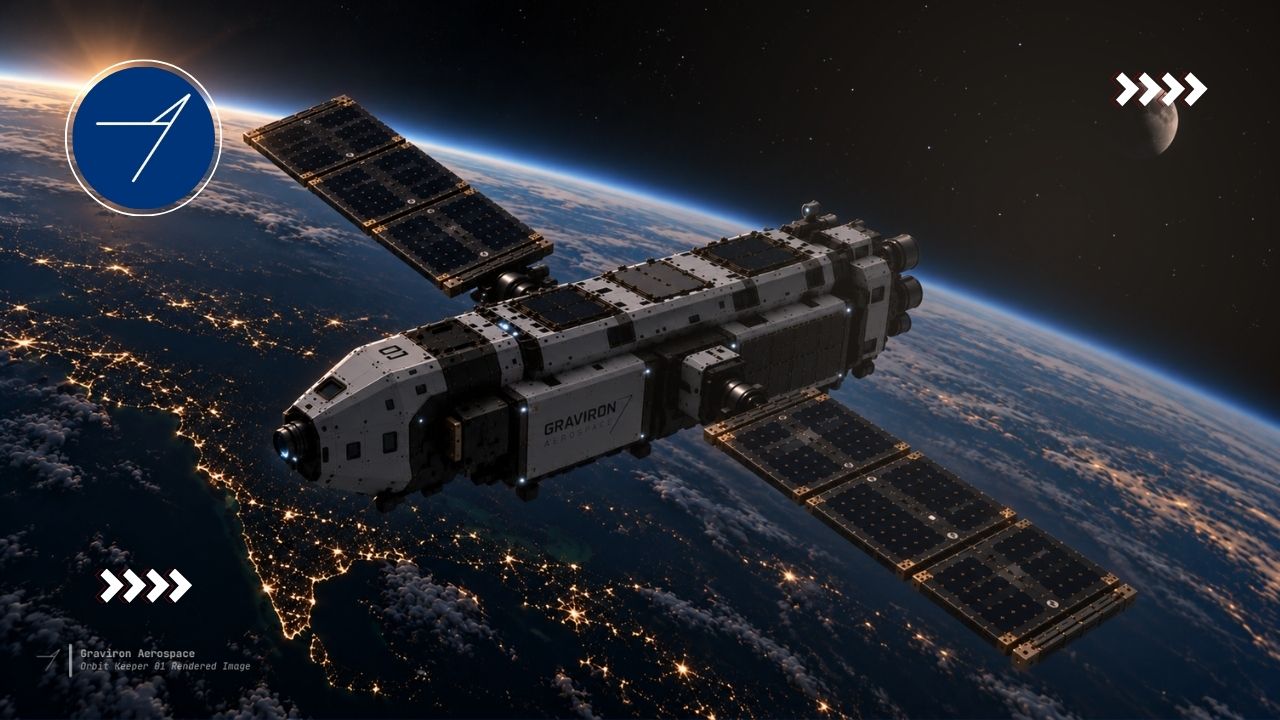
Graviron Aerospace’s current commercial priority is Orbit Keeper 01 Vector, a standardized orbital platform being developed to provide hosted payload and orbital computing services in Low Earth Orbit.
Vector is intended to give commercial customers access to orbital capabilities through defined payload interfaces and platform resource allocations. Its first commercial mission is targeted for Q2 2028, with the mission intended to carry commercial customer payloads alongside Graviron’s orbital-computing capability.
Beginning in late 2028, Graviron plans to focus on fleet development, informed by engineering findings and experience gained through orbital operations.
Orbit Keeper 01 is not being presented as a Reusable Orbital Drone. Its current purpose is to establish Graviron’s initial commercial services in hosted payloads and orbital computing.
The Reusable Orbital Drone concept belongs to Graviron’s longer-term vehicle-development roadmap. Future vehicles may be designed around repeated mission cycles, greater orbital mobility, configurable mission capabilities, and the technical systems required for reuse.
Those future capabilities will require their own engineering development and validation. They should not be assumed to be features of Vector or of every future Orbit Keeper configuration.
The two directions fit within a broader company vision: developing standardized orbital platforms now while continuing to consider the vehicle architectures that could support more complex operations in space over time.
A longer-term direction for orbital operations
Much of spaceflight has historically followed a pattern: build a spacecraft, launch it, operate it, and eventually retire it.
Reusable orbital vehicles offer another possible model: develop a vehicle designed for repeated missions, perform useful work, assess its condition, and return it to service when its architecture and operating constraints permit.
Achieving this will require progress in propulsion, navigation, autonomy, modular interfaces, vehicle durability, and operational infrastructure. No single technology resolves the entire challenge.
The opportunity lies in integrating these capabilities into vehicles and fleets whose economics and engineering support repeated orbital work.
At Graviron, our immediate priority is developing Orbit Keeper 01 for hosted payloads and orbital computing. Reusable orbital vehicles remain part of our longer-term technical vision as we work toward expanding what commercial platforms can do in space.
The future of space will depend not only on putting spacecraft into orbit, but also on developing the infrastructure and vehicles that allow humanity to do more once they are there.
Want to go deeper?
Our technical whitepaper explores the Reusable Orbital Drone concept, its defining characteristics, potential mission applications, engineering challenges, autonomy, safety, and long-term role in orbital infrastructure.
Reusable Orbital Drones — Technical Whitepaper
Graviron Aerospace, Inc.