Blog
What Happens When Cislunar Space Gets Crowded?

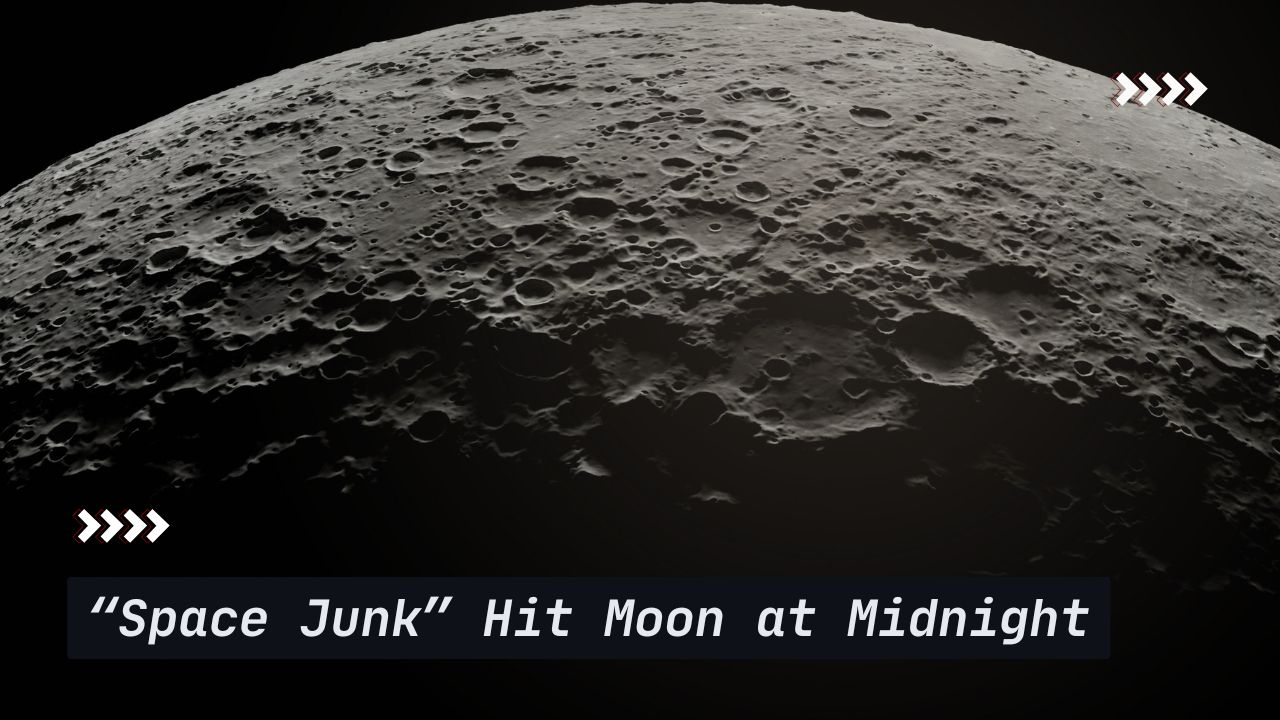
The recent Falcon 9 lunar impact is more than a debris story. It is a preview of the operational challenges that will emerge as humanity builds a permanent presence around the Moon.
On August 5, 2026, a spent SpaceX Falcon 9 upper stage struck the Moon at approximately 5,400 miles per hour.
The rocket stage had spent more than a year traveling through cislunar space after completing its mission to deliver commercial lunar spacecraft in January 2025. It was not a spacecraft designed to operate around the Moon indefinitely. It was a piece of launch hardware that had completed its original purpose and eventually found itself on a collision course with the lunar surface.
The impact itself was not catastrophic. No people were harmed, and no operational spacecraft were destroyed. But the event deserves considerably more attention than a headline about a rocket hitting the Moon. Because the real question is not: “Why did a rocket hit the Moon?” The real question is: What happens when cislunar space gets crowded?
Cislunar Space Is Becoming an Operating Environment
Cislunar space broadly describes the region extending from Earth’s vicinity toward and around the Moon. For decades, most human space activity has been concentrated in relatively familiar orbital regimes around Earth — particularly Low Earth Orbit and Geostationary Orbit.
That is changing.
NASA, commercial lunar companies, international space agencies and national security organizations are increasingly planning missions that operate between Earth and the Moon, around the Moon, and on the lunar surface.
NASA’s current approach increasingly treats lunar exploration as an ecosystem rather than a sequence of isolated missions. Its commercial lunar initiatives are intended to establish recurring transportation and logistics capabilities, while newer NASA efforts explicitly discuss resilient cislunar infrastructure and high-tempo logistics required for sustained lunar operations.
That means the future lunar environment will not simply contain a handful of spacecraft arriving occasionally.
It could contain:
- Lunar orbiters
- Communications and navigation satellites
- Cargo and transportation vehicles
- Landers and ascent vehicles
- Scientific spacecraft
- Commercial spacecraft
- Space stations and infrastructure
- Government and defense assets
- Spent rocket stages and other mission hardware
- Servicing and logistics vehicles
And all of these objects will have to operate in the same gravitational environment. The Moon is not an empty destination anymore. It is becoming a place where infrastructure will need to operate.
The Falcon 9 Impact Was a Warning — Not Because It Was Unusual
There is an important distinction to make. The Falcon 9 upper stage did not suddenly become a dangerous object because someone ignored a debris warning. Its trajectory was influenced by the complex gravitational environment of the Earth-Moon system and solar forces after its original mission.
The problem is that cislunar trajectories are fundamentally different from the relatively predictable orbital regimes around Earth. An object can remain in space for a very long time without having an obvious, simple path back to Earth; and when the number of missions increases, the number of objects operating in these environments increases as well. That creates a new category of operational problem:
How do we know where everything is, how it is moving, what it might encounter, and what we can do about it?
The August impact demonstrated that this is not a theoretical question. South Korea’s Danuri lunar orbiter had to deal with the incoming object’s trajectory, while NASA’s Lunar Reconnaissance Orbiter later captured before-and-after imagery of the resulting crater. The crater measures approximately 18 meters across and less than 3 meters deep.
The event also produced scientific data. Ground-based observations detected sodium and lithium signatures in the impact plume, giving researchers an unusual opportunity to study a lunar impact where the impacting object’s mass, origin and trajectory were known.
In other words, the event was scientifically valuable. But it was also operationally instructive.
JUST IN: NASA reveals the impact site where a SpaceX Falcon 9 rocket stage crashed into the Moon at 5,400 MPH, leaving behind a new crater. pic.twitter.com/q0ioxHvprW
— Polymarket (@Polymarket) August 18, 2026
The Risk Is Bigger Than Lunar Debris
It is tempting to think about this as simply another version of Earth’s orbital debris problem. It isn’t.
Earth orbit has become increasingly congested with satellites, rocket bodies and fragments. There are established tracking networks, collision-avoidance procedures, conjunction assessments and increasingly sophisticated debris-mitigation technologies.
Cislunar space presents a different challenge. Distances are greater. Communication delays and visibility constraints become more significant. Orbital dynamics become more complicated; and the infrastructure available to inspect, maneuver, service or relocate spacecraft is still extremely limited.
As one U.S. Space Force leader put it in 2026, “space domain awareness out at cislunar” requires different math and different tools. The service has also emphasized the need for continuous, low-latency communications in the region.
That statement captures an important point: We cannot simply take today’s Earth-orbit infrastructure and extend it outward. Cislunar operations require a different infrastructure layer.
Cislunar Space Is Also Becoming a Strategic Environment
The commercial opportunity is only half of the story. The other half is national security. The United States, China and other spacefaring nations are increasingly interested in the Earth-Moon system for scientific, economic and strategic reasons. For defense organizations, cislunar space matters because future military and national-security infrastructure may extend beyond traditional Earth orbits.
The U.S. Space Force has already been developing capabilities dedicated to cislunar domain awareness. Its efforts include technologies intended to discover and maintain custody of objects operating between Earth and the Moon; and U.S. Space Command has been increasingly explicit about the strategic importance of the region.
Gen. Stephen Whiting has described Earth as the “rear” relative to future operations in GEO and cislunar orbits, arguing that relying entirely on terrestrial sustainment would create extremely long supply chains.
That has major implications. A future military spacecraft operating around the Moon may not be able to simply wait for a replacement vehicle to launch from Earth. A damaged spacecraft may need inspection. An asset may need to be relocated. A spacecraft may need additional propulsion or support. A communications or navigation architecture may require servicing.
In other words: space logistics becomes a national-security capability.
And Commercial Space Will Need the Same Infrastructure
The commercial case may be even more straightforward. A growing lunar economy will require transportation. Transportation will require infrastructure. Infrastructure will eventually require maintenance; and maintenance will require vehicles capable of operating around other spacecraft.
Imagine a future in which a company operates a communications satellite in lunar orbit.
What happens if:
- its orbit needs to be adjusted?
- a subsystem begins behaving abnormally?
- another spacecraft needs to inspect it?
- a payload needs to be delivered?
- an asset needs to be relocated?
- a spacecraft reaches the end of its useful life?
- a piece of mission hardware becomes a navigation hazard?
Launching another spacecraft from Earth for every one of these problems is expensive, slow and operationally inefficient. That is where in-space logistics becomes a market rather than simply a technical capability.
NASA’s own commercial strategy is moving toward recurring lunar transportation, logistics and infrastructure. Its 2026 “Ignition” initiative specifically calls for commercial architectures capable of supporting high-tempo transportation, logistics resupply and crew rotation for lunar operations.
The market is therefore beginning to validate a fundamental shift: launching spacecraft is only the beginning of the mission.
From Debris Removal to Space Logistics
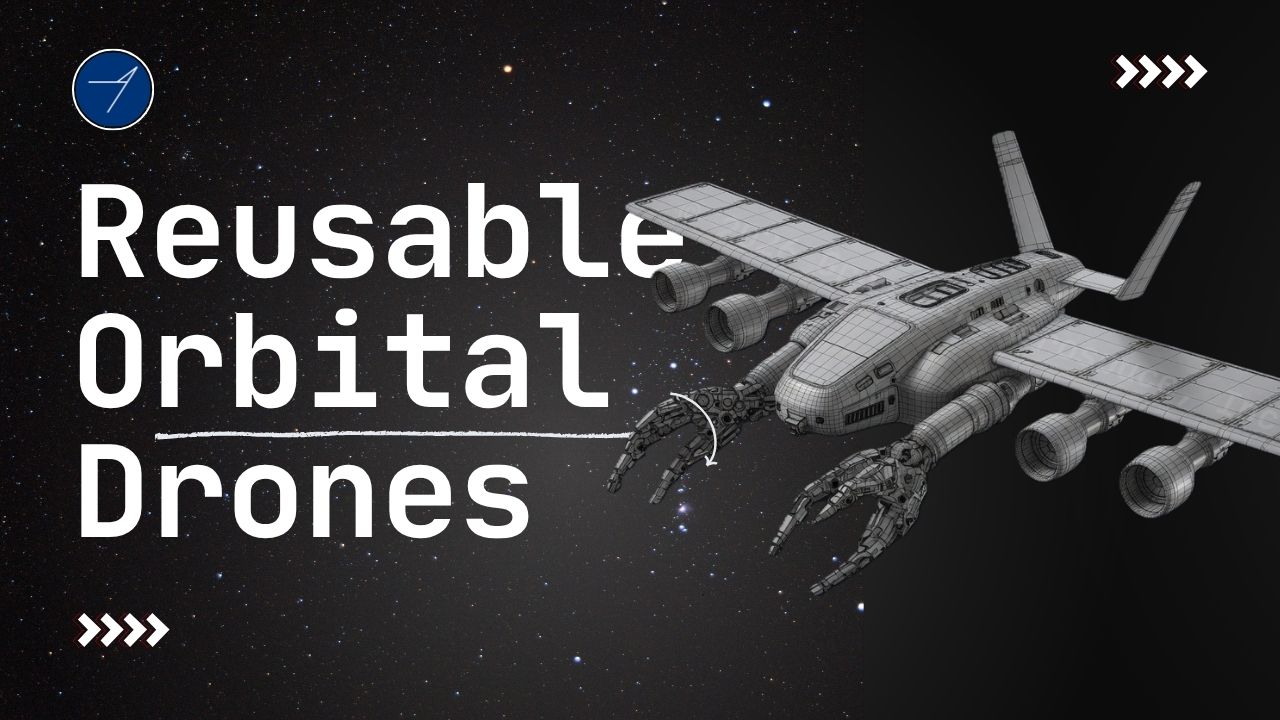
At Graviron Aerospace, we think about this problem from a slightly different perspective. We are not building a spacecraft whose only purpose is to remove debris. We are building reusable orbital drones for space logistics and post-launch services.
Our Orbit Keeper platform is being developed around a common architecture capable of supporting missions such as orbital transfer, satellite inspection, hosted payload operations, emergency response and, over time, satellite servicing and debris-management operations.
The fundamental idea is simple: one reusable vehicle should be able to perform multiple missions throughout its operational lifetime.
Instead of launching a new dedicated spacecraft for every problem, a reusable orbital platform can become a persistent logistics asset. That architecture begins in Low Earth Orbit, where Graviron is focused on developing flight heritage and validating its autonomous orbital operations. But the underlying technologies are not limited to LEO.
Rendezvous.
Proximity operations.
Autonomous navigation.
Inspection.
Orbital maneuvering.
Mission-specific interfaces.
Reusable spacecraft architectures.
These capabilities form the technological foundation for a much broader future, including higher orbits and eventually cislunar operations.
What Could Cislunar Debris Management Look Like?
Future debris management around the Moon will probably not look exactly like today’s active debris removal missions in Earth orbit. The objective may not always be to “remove” an object. Sometimes the best solution could be to:
Inspect → Identify → Characterize → Relocate → Service → Deorbit or Dispose
depending on the mission and environment. A reusable orbital drone could potentially inspect an inactive spacecraft before a decision is made. It could help determine whether an object is genuinely hazardous. It could support controlled relocation of certain spacecraft or mission hardware. It could provide proximity operations around assets that are difficult or impossible to reach from Earth; and eventually, dedicated variants could perform more advanced debris-management or end-of-life missions. That is the direction Graviron is working toward. Not simply debris removal. Orbital infrastructure.
The Commercial Opportunity Is Bigger Than Debris
There is also an important economic distinction. Debris removal alone may be a relatively narrow market. Space logistics is much larger. The same platform that can eventually support debris-management missions can potentially generate revenue from commercial customers long before the debris-removal market fully develops.
A reusable orbital drone can serve:
Commercial customers
- Orbital transfer
- Satellite inspection
- Hosted payloads
- Emergency response
- Servicing
- End-of-life operations
Government and defense customers
- Spacecraft inspection
- Responsive orbital operations
- Asset relocation
- Space domain support
- Mission-specific proximity operations
- Future cislunar logistics and sustainability missions
That creates a fundamentally different business model.
Instead of waiting for a large debris-removal contract, a reusable platform can operate across multiple mission categories and customer segments throughout its lifetime. This is one reason we believe the future of orbital sustainability will increasingly overlap with the future of space logistics.
The Infrastructure Race Has Already Started
The most important takeaway from the Falcon 9 impact is not that a rocket hit the Moon. It is that the event happened at the beginning of what could become a much larger transition. NASA is planning recurring lunar transportation and logistics. Commercial companies are developing lunar landers, spacecraft and infrastructure. Governments are establishing cislunar domain-awareness capabilities. Defense organizations are studying how to operate and sustain assets beyond traditional Earth orbits; and the number of objects operating in the Earth-Moon system will continue to increase.
The question is no longer whether cislunar space will become more active. It will. The question is whether the infrastructure required to safely and efficiently operate there will arrive before the traffic does.
Building Before the Traffic
At Graviron, we believe the answer has to be yes. The future space economy cannot depend on every spacecraft being isolated, disposable and entirely self-sufficient. Just as aircraft depend on airports, ships depend on ports and terrestrial industries depend on logistics networks, spacecraft will increasingly depend on in-space infrastructure.
Orbit Keeper is our step toward building that infrastructure. Today, that means developing reusable orbital drones for post-launch services in Low Earth Orbit. Tomorrow, it can mean servicing spacecraft in more complex orbital environments; and eventually, it can mean providing the logistics and sustainability infrastructure required to support a permanent human and commercial presence throughout cislunar space.
The Falcon 9 upper stage that struck the Moon was a single object. The future will contain thousands of missions. The difference between those two futures will depend on whether we build the infrastructure to manage them.
Space doesn’t end at launch. Neither should spacecraft.
The Team, Graviron Aerospace, Inc.