

Blog
What Are Orbital Data Centers? Architecture, Applications and How They Work

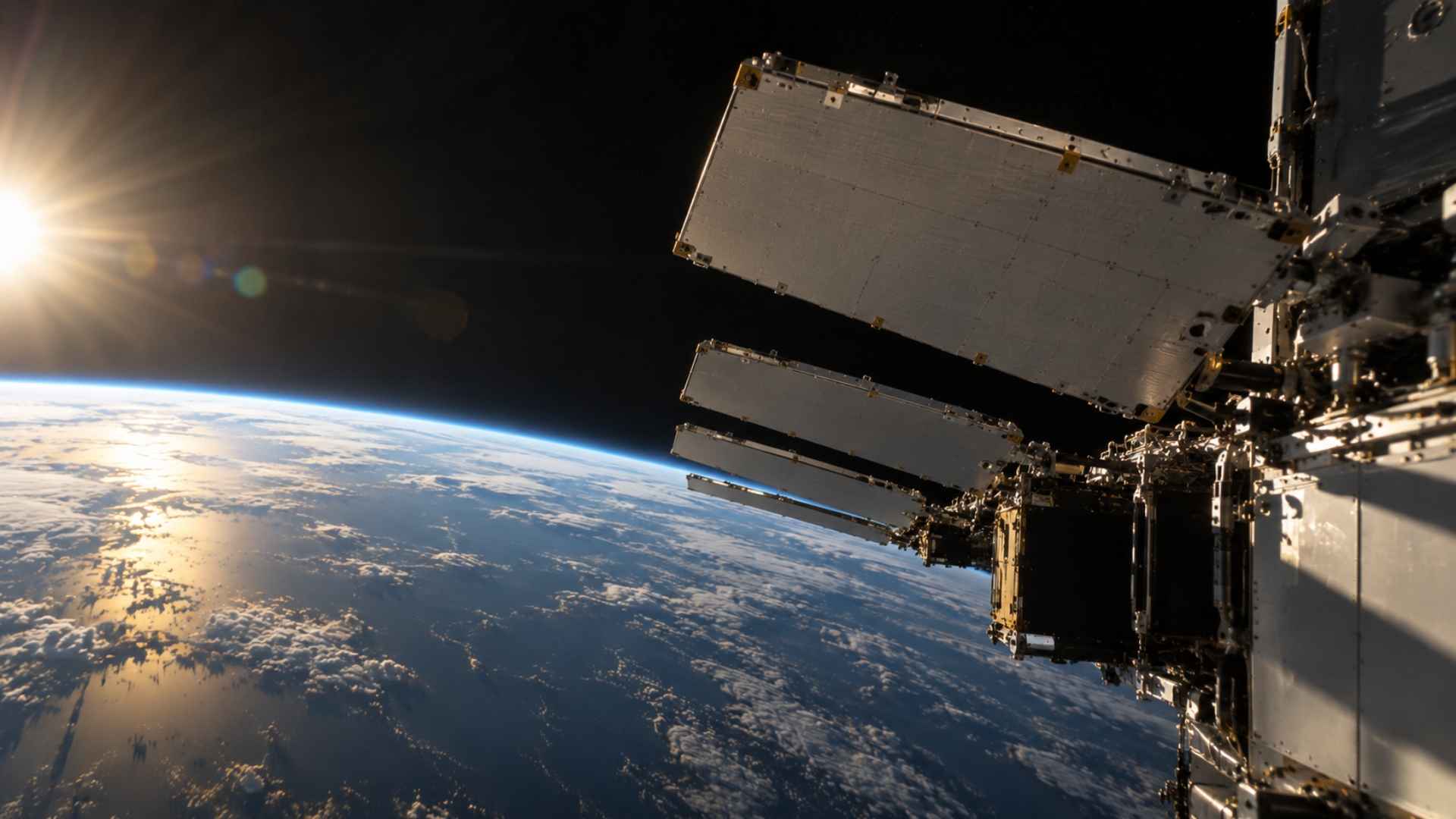
The infrastructure powering the digital world is undergoing a significant transformation. Artificial intelligence, cloud computing, large-scale data processing, and increasingly sophisticated software applications are driving unprecedented demand for computational resources.
Behind these technologies are terrestrial data centers: enormous facilities containing thousands of servers, networking equipment, storage systems, and cooling infrastructure. They form the backbone of the modern digital economy.
However, the expansion of computing infrastructure is creating new engineering and energy challenges. Electricity availability, cooling requirements, land constraints, grid capacity, and infrastructure costs are becoming increasingly important considerations for data center operators.
What if some of this computing infrastructure could operate beyond Earth’s atmosphere?
Orbital data centers explore precisely this possibility: deploying computing infrastructure in Low Earth Orbit (LEO), using solar energy to power onboard computing systems and interconnected satellites to distribute processing capacity across space.
Rather than relying exclusively on terrestrial facilities, orbital data centers aim to establish an additional computing infrastructure layer above Earth, capable of supporting workloads traditionally handled by ground-based data centers.
At Graviron Aerospace, we are developing this vision through a distributed architecture of standardized Orbit Keeper satellites, designed to progressively expand computing capacity in orbit.
01. What Are Orbital Data Centers?
An orbital data center is a computing infrastructure deployed in space, consisting of servers, processing units, storage systems, power-generation equipment, thermal-management systems, and communication technologies.
Unlike conventional satellite computing, which primarily processes information collected by onboard instruments and sensors, orbital data centers are intended to support computing workloads originating beyond the spacecraft itself.
This distinction is important.
Traditional orbital edge computing focuses on processing information closer to where it is generated in space. For example, an Earth-observation satellite might process its own imagery before transmitting selected results to a ground station.
An orbital data center has a broader objective: providing computing resources in orbit that can eventually take over suitable workloads currently running in terrestrial data centers.
These workloads could include selected AI computations, batch processing, scientific simulations, rendering, and other computationally intensive applications that can tolerate the communication and latency characteristics of space-based infrastructure.
The underlying concept is to establish computing nodes in orbit, connect them through high-capacity communication links, and coordinate their resources as a larger distributed computing system.
In simple terms, orbital data centers bring computing infrastructure into space rather than limiting data processing and storage to facilities on Earth.
02. Why Are Orbital Data Centers Necessary?
The demand for computing infrastructure is increasing rapidly, particularly as artificial intelligence becomes integrated into commercial, scientific, and industrial applications.
This is not simply a projection about future technology. It is already reflected in global electricity consumption.
The growing energy requirements of data centers
According to the International Energy Agency (IEA), global data centers consumed approximately 415 terawatt-hours (TWh) of electricity in 2024, representing around 1.5% of global electricity consumption.
The IEA projects that this figure could increase to approximately 945 TWh by 2030, more than doubling within six years.
Data center electricity consumption has also grown at approximately 12% annually since 2017.
In the United States, a June 2026 update from Lawrence Berkeley National Laboratory estimates that data centers could account for 11.8% of total national electricity consumption by 2030, with a scenario range of 9.5% to 15.3%.
These figures demonstrate the scale of the infrastructure challenge facing the computing industry.
Understanding the limitations of terrestrial infrastructure
Expanding a conventional data center requires more than purchasing additional servers.
Operators must also secure:
- Sufficient electricity generation and grid capacity.
- Land and suitable locations for large facilities.
- Cooling infrastructure capable of managing substantial heat generation.
- Reliable networking and connectivity.
- Physical infrastructure for maintenance, expansion, and operations.
As computing requirements increase, these supporting systems become increasingly important.
Orbital data centers explore an alternative infrastructure environment, where solar energy is available beyond atmospheric interference and waste heat can ultimately be rejected through thermal radiation.
The opportunity beyond Earth
Space offers several characteristics that make it interesting for large-scale computing infrastructure.
1. Access to solar energy
Outside Earth’s atmosphere, incoming solar radiation is approximately 1,361 watts per square metre on a surface directly facing the Sun.
In appropriately selected orbits, spacecraft can receive sunlight for much longer periods than ground-based solar installations, potentially reducing dependence on large energy-storage systems.
2. An alternative thermal environment
Space provides a fundamentally different environment for heat rejection.
Terrestrial data centers generally rely on air cooling, liquid cooling, chillers, cooling towers, and other heat-management infrastructure.
In orbit, heat must ultimately be transferred to radiating surfaces and emitted into space. This creates an opportunity for different thermal architectures, although designing sufficiently large and effective radiators remains a major engineering challenge.
3. Additional infrastructure capacity
Orbital infrastructure could provide another location for deploying computing resources without requiring every additional unit of computing capacity to be installed in a terrestrial facility.
The objective is not necessarily to eliminate Earth-based data centers, but to develop an additional infrastructure layer capable of supporting suitable workloads.
03. How Do Orbital Data Centers Work?
An orbital data center requires several interconnected technological systems to function together.
At its foundation, the architecture consists of computing hardware, electrical power generation, thermal management, data storage, networking, and ground infrastructure.
A. Computing infrastructure
The computing layer consists of processors, memory, storage, and networking hardware installed aboard spacecraft.
Depending on the intended workloads, this infrastructure could incorporate:
- Central Processing Units (CPUs).
- Graphics Processing Units (GPUs).
- AI accelerators.
- High-speed memory.
- Solid-state storage.
- Network interfaces and onboard computing controllers.
These components perform the actual computational work.
For example, an AI workload could be divided into smaller independent tasks and distributed across multiple computing nodes. Each node processes its allocated workload before returning results through the network.
More tightly coupled applications, such as large-scale distributed AI training, require substantially faster communication between computing nodes.
Consequently, the computing architecture must be designed alongside the networking infrastructure rather than treated as an independent subsystem.
B. Solar power generation
Electricity is one of the most important requirements of any data center.
Orbital computing systems can use photovoltaic solar arrays to generate electricity directly from sunlight.
NASA measurements place solar irradiance at approximately 1,361 W/m² at Earth’s average orbital distance from the Sun, measured at the top of the atmosphere on a surface facing the Sun.
The amount of usable electricity depends on several factors:
- Solar-cell efficiency.
- Panel orientation.
- Available illuminated area.
- Degradation over the mission lifetime.
- Power-conversion efficiency.
- Orbital eclipse periods.
Dawn-dusk Sun-synchronous orbits are particularly interesting because they can provide near-continuous solar exposure under suitable orbital conditions.
However, not every orbit provides continuous sunlight. Batteries or other energy-storage systems may still be necessary to support eclipse periods, transient loads, and spacecraft operations.
C. Thermal management and heat rejection
Cooling is one of the most significant engineering challenges associated with orbital data centers.
Computing hardware converts electrical energy into useful computation and heat. Almost all the electrical power consumed by the computing equipment ultimately becomes heat that must be rejected.
On Earth, data centers commonly use air and liquid cooling systems to transfer heat away from processors and eventually release it into the surrounding environment.
Space is different.
A spacecraft operates in a vacuum, meaning conventional air-based cooling cannot be used to transfer heat into the surrounding environment.
Instead, thermal systems must conduct heat away from processors and transport it to radiator surfaces, which reject energy through infrared radiation.
These systems may incorporate:
- Thermal straps and conductive interfaces.
- Heat pipes.
- Pumped-fluid thermal loops.
- Radiator panels.
- Multi-layer insulation.
- Temperature sensors and thermal-control electronics.
Radiator sizing depends on the amount of heat generated, operating temperature, surface emissivity, environmental heat loads, and radiator orientation.
The Stefan–Boltzmann relationship describes the idealized radiative heat emission:
[
P = \epsilon \sigma A T^4
]
Where:
- (P) = radiated thermal power.
- (\epsilon) = surface emissivity.
- (\sigma) = Stefan–Boltzmann constant.
- (A) = radiator surface area.
- (T) = absolute radiator temperature in kelvin.
This illustrates why thermal management must be engineered alongside computing capacity. Increasing the electrical power available to processors also increases the heat that the spacecraft must reject.
D. Inter-satellite communication
A distributed orbital data center requires communication links between its computing nodes.
Free-space optical communication, commonly called laser communication, is a promising technology for this purpose.
Optical terminals can establish high-capacity connections between satellites without requiring physical cables.
These links could support:
- Workload distribution between computing nodes.
- Transfer of intermediate computing results.
- Data replication and synchronization.
- Coordination between spacecraft.
- Communication with orbital relay infrastructure.
However, the network architecture matters enormously.
Satellites distributed across large orbital distances cannot automatically behave like servers connected inside a terrestrial data center. Communication latency, bandwidth, link availability, and synchronization become limiting factors.
For tightly coupled computing workloads, satellites may need to operate in coordinated clusters with high-bandwidth optical interconnections.
For loosely coupled workloads, a more widely distributed constellation may be sufficient.
E. Ground infrastructure and connectivity
Orbital data centers will still require connections to Earth.
Ground stations, communication networks, gateways, and cloud infrastructure provide the interface between orbital computing resources and terrestrial users.
A typical data path could look like this:
- A customer submits a computing workload.
- The workload is transmitted through terrestrial networking infrastructure.
- A ground gateway forwards the workload to the orbital network.
- An orbital computing node receives and executes the workload.
- Results are transferred between orbital nodes when necessary.
- The completed results are transmitted back to Earth.
- The customer retrieves the output through the appropriate endpoint.
The efficiency of this process depends on uplink and downlink bandwidth, orbital visibility, network scheduling, workload size, and communication latency.
For this reason, workloads that require constant low-latency communication with Earth may remain better suited to terrestrial data centers.
04. Understanding the Distributed Architecture
One of the possible approaches to developing orbital data centers is a distributed satellite architecture.
Instead of depending entirely on a single enormous spacecraft or structure, computing capacity can be distributed across multiple standardized spacecraft.
Each spacecraft acts as an individual computing node, while interconnected nodes form larger computing clusters.
The architecture can be understood through three layers.
Layer 1: Computing nodes
Each satellite carries computing hardware, power-generation equipment, thermal-management systems, storage, and communication interfaces.
These spacecraft provide the individual units of computing capacity.
Layer 2: Orbital computing clusters
Multiple satellites establish coordinated communication links and operate as a computing cluster.
Depending on their separation, networking capability, and workload requirements, these clusters can distribute computational tasks between their nodes.
Layer 3: Distributed orbital infrastructure
Multiple computing clusters can form a wider orbital infrastructure network.
As additional spacecraft are deployed, computing capacity can be expanded progressively.
This architecture offers a modular approach to infrastructure development: additional capacity can be introduced through additional spacecraft rather than requiring every expansion to depend on one large structure.
Importantly, distributing servers across satellites does not automatically make them one tightly integrated data center. The networking, workload scheduling, fault management, and communication architecture must support that level of coordination.
05. Real-World Research and Industry Development
Orbital data centers are moving beyond theoretical discussions, with major technology companies and research institutions investigating the engineering requirements.
Several developments demonstrate the growing interest in this field.
Google Project Suncatcher
In November 2025, Google announced Project Suncatcher, a research initiative exploring the possibility of operating machine-learning infrastructure through interconnected, solar-powered satellites.
The proposed architecture incorporates:
- Google Tensor Processing Units (TPUs).
- Solar-powered spacecraft.
- Free-space optical communication.
- Coordinated satellite constellations.
- Research into radiation tolerance and orbital operations.
In September 2026, Google provided further details about its hardware testing, thermal-management research, and planned orbital demonstrations.
Its research highlights the importance of developing high-bandwidth optical communication links capable of supporting large computing workloads.
Orbital data center feasibility research
A 2026 technical study titled Orbital Data Centers: Spacecraft Constraints and Economic Viability examined the relationship between computing power, solar arrays, radiator requirements, spacecraft mass, and launch economics.
For one illustrative 1-megawatt computing-infrastructure scenario, the study estimated:
| Infrastructure component | Illustrative requirement |
|---|---|
| Solar array area | 5,640 m² |
| Radiator area | 2,500 m² |
| Solar, storage and radiator mass | 29.4 kg/kW |
| Total infrastructure mass intensity | 34–59 kg/kW |
These are research-model estimates, not demonstrated commercial system specifications. They illustrate the scale of the power-generation and heat-rejection infrastructure required.
The broader industry opportunity
The IEA’s energy projections and the emergence of research programmes such as Project Suncatcher demonstrate that orbital computing is being investigated as a potential extension of future digital infrastructure.
However, commercial deployment will depend on solving several interconnected problems, including launch economics, spacecraft lifetime, radiation protection, thermal management, high-speed communications, and operational reliability.
06. Engineering Challenges and Limitations
Despite its potential, orbital data center infrastructure faces significant engineering challenges.
Power generation and storage: Large computing workloads require substantial electrical power. Generating, distributing, storing, and managing this power aboard spacecraft requires carefully engineered systems.
Thermal rejection: Radiators must reject enormous amounts of waste heat without exceeding spacecraft mass, area, and thermal constraints.
Radiation exposure: High-energy particles can cause electronic failures, memory errors, and degradation of semiconductor components. Radiation-tolerant hardware, shielding, error correction, and fault recovery are essential.
Communication bandwidth: Transferring large datasets between Earth and orbit requires high-capacity communication systems. Inter-satellite networking must also support the intended distributed workloads.
Orbital debris and collision avoidance: Satellites operate in an increasingly congested orbital environment. Spacecraft must incorporate tracking, collision-risk assessment, maneuvering capabilities, and end-of-life disposal strategies.
Hardware replacement and maintenance: Terrestrial data centers can replace individual servers relatively easily. Orbital infrastructure requires more complicated servicing, replacement, or deorbiting procedures.
Commercial economics: Launch, manufacturing, deployment, operations, replacement, and communication costs must be evaluated against the cost of delivering equivalent computing capacity on Earth.
Ultimately, the commercial viability of orbital data centers will depend on the complete lifecycle economics of the infrastructure, not simply the availability of sunlight.
07. Graviron Aerospace: Developing Distributed Data Centers in Orbit
At Graviron Aerospace, we are developing a distributed approach to orbital data center infrastructure through our standardized Orbit Keeper spacecraft platform. Our objective is to progressively establish computing infrastructure in Low Earth Orbit through a fleet of interconnected spacecraft rather than relying exclusively on a single large orbital structure.
The architecture is based on standardized spacecraft that can be developed, deployed, and expanded as computing requirements increase. Orbit Keeper: The foundation of the architecture Orbit Keeper is Graviron’s spacecraft platform, designed to provide a standardized foundation for orbital infrastructure.
Building toward a distributed computing fleet
The longer-term direction is to expand the Orbit Keeper platform into a network of computing spacecraft.
As the architecture develops, future spacecraft generations are intended to support greater computing capacity, enhanced electrical power generation, improved thermal-management systems, and higher-capacity inter-satellite communications.
The objective is to establish coordinated orbital computing clusters and progressively expand them into a distributed data center infrastructure.
Rather than assuming that every spacecraft must carry the same computing configuration, the architecture can evolve as power, thermal, networking, and customer requirements become better understood.
A scalable approach to orbital infrastructure
A distributed architecture provides several potential advantages:
Incremental expansion: Computing capacity can be added progressively as additional spacecraft are deployed.
Modular development: Individual spacecraft and computing modules can be developed and tested as separate engineering units.
Fault isolation: A failure affecting one spacecraft does not necessarily require the entire network to stop operating, provided workloads and services are designed with sufficient redundancy.
Fleet flexibility: Different spacecraft generations can introduce improved computing hardware, power systems, communications, and thermal capabilities.
Distributed risk: Computing resources are not concentrated entirely in one physical spacecraft. However, the fleet still shares orbital, launch, communication, and operational risks.
Our vision is to develop a standardized orbital infrastructure platform that can grow from individual computing nodes into interconnected computing clusters and, ultimately, a large-scale distributed data center network.
08. The Future of Computing Infrastructure
Orbital data centers represent a potential new direction for the development of global computing infrastructure.
As artificial intelligence, scientific computing, and digital services continue to expand, the demand for electricity, cooling, networking, and physical infrastructure will remain important considerations for the data center industry.
Moving selected computing workloads into orbit could create additional opportunities for generating energy, distributing computing resources, and developing infrastructure beyond terrestrial facilities.
However, achieving this vision requires more than launching computers into space. It requires coordinated advances in spacecraft engineering, electrical power systems, thermal management, semiconductor reliability, optical communication, distributed computing, and commercial operations.
The transition will likely happen progressively, beginning with individual computing demonstrations and expanding toward larger interconnected systems as the underlying technologies and economics mature.
Graviron Aerospace is developing toward that future: a distributed network of standardized Orbit Keeper spacecraft designed to establish scalable data center infrastructure in orbit.
The objective is not simply to put computers in space. It is to develop another place where the world’s computing infrastructure can operate.
References & Further Reading
- International Energy Agency — Energy and AI (2025): Global data-center electricity consumption and 2030 projections. Read IEA research.
- Lawrence Berkeley National Laboratory — US Data Center Energy Usage Report (2025 Update, published June 2026): US electricity demand projections. Read the report.
- NASA — Thermal Control: Spacecraft thermal-management technologies and radiator systems. Read NASA technical material.
- NASA — Solar Irradiance: Measurements of solar radiation at Earth’s orbital distance. Read NASA research.
- Google Research — Project Suncatcher: Space-based machine-learning infrastructure, solar-powered satellites, and optical networking. Read Google research.
- Orbital Data Centers: Spacecraft Constraints and Economic Viability (2026): Technical modelling of power, radiator area, spacecraft mass, and economics. Read the research paper.
- ESA — Space Environment Report 2025: Orbital debris and collision environment. Read ESA report