
Space Logistics for
Post-launch Services
Graviron Aerospace is developing reusable autonomous orbital drones to enable the next generation of in-space operations.
A Different Approach to Space Operations
Today's spacecraft are typically designed for a single mission. Once launched, their capabilities are largely fixed, limiting flexibility throughout their operational lifetime.
We're taking a different approach.
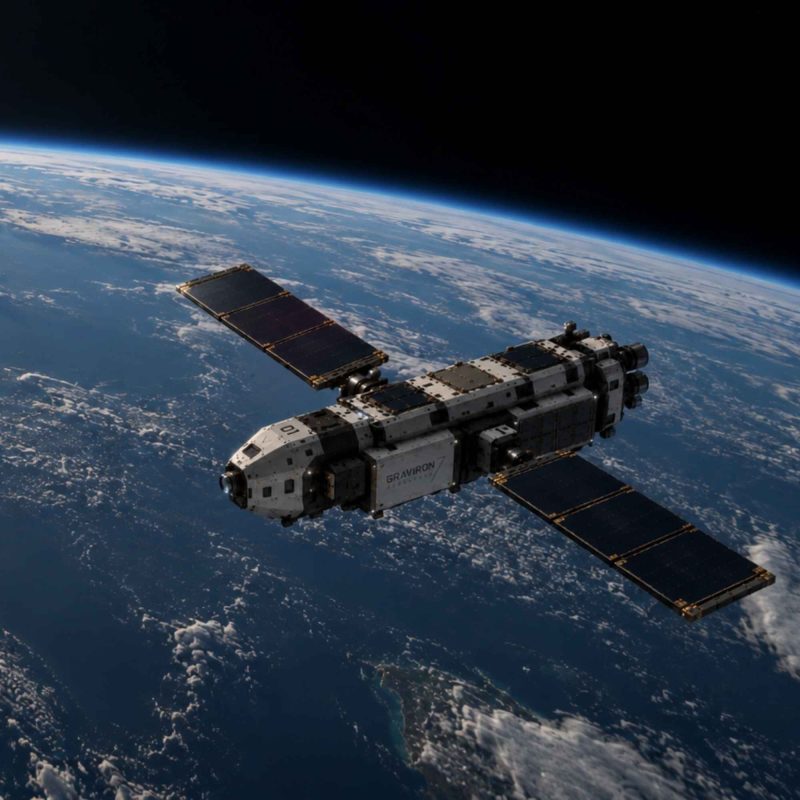
We're developing Orbit Keeper — a family of reusable autonomous orbital drones designed to perform multiple mission types using a common, upgradeable platform. Rather than building a new spacecraft for every problem, we continuously expand one reusable system with new capabilities over time.
This approach reduces development costs, improves operational flexibility, and creates a scalable foundation for orbital logistics, satellite servicing, sustainability, and future space infrastructure.
Reusable by Design
Designed to fly multiple missions instead of being discarded after a single use.
Modular Architecture
New capabilities can be added through upgrades rather than entirely new spacecraft.
Autonomous Operations
Built to perform complex orbital missions with minimal human intervention.
One Platform. Multiple Missions.
A common platform capable of supporting logistics, servicing, inspection, sustainability, and future in-space operations.
Launch Is Only the Beginning.
Getting a spacecraft into orbit is only the first step.
Once there, it may need to be deployed, relocated, inspected, serviced, upgraded, or eventually retired.
Graviron is building the systems that make those post-launch operations possible.
Our Mission
To make in-space operations more accessible by developing reusable autonomous orbital drones that reduce the cost, complexity, and limitations of operating in space.
Our Vision
To build the world's leading platform for reusable orbital services, enabling satellites, spacecraft, and future space infrastructure to operate more efficiently throughout their entire lifecycle.
One Platform.
Unlimited Possibilities.
We're building Orbit Keeper — a family of reusable autonomous orbital drones designed to perform a wide range of in-space missions from a common, upgradeable platform.
Rather than designing a new spacecraft for every mission, Orbit Keeper is built to evolve over time through new hardware, software, and mission capabilities. This modular approach enables a single platform to support multiple categories of orbital services while continuously expanding what it can do.
Orbit Keeper Product Family
First-generation reusable orbital drone
Focused on commercial Low Earth Orbit (LEO) missions, including orbital logistics, inspection, hosted payloads, and satellite support.
Advanced servicing platform
Expands into higher-complexity orbital servicing, satellite maintenance, relocation, and autonomous rendezvous operations.
Infrastructure for the future space economy
Future generations designed to support large-scale orbital infrastructure, long-duration missions, and next-generation space operations.
Platform Capabilities
Orbital Logistics
Moving spacecraft where they need to be.
Satellite Servicing
Supporting spacecraft throughout their operational lifetime.
Inspection
Autonomous proximity operations and spacecraft assessment.
Hosted Payloads
Providing flight opportunities for new technologies and experiments.
Sustainability
Responsible end-of-life support, re-orbiting, and future debris mitigation.
Future Infrastructure
Building toward a reusable orbital ecosystem.
The Next Chapter of Space Is Just Beginning
Space is entering a new era — one where access is no longer the greatest challenge. The focus is shifting toward building the infrastructure that will support scientific discovery, commercial activity, national security, and future exploration for decades to come.
As launch costs continue to fall and orbital activity accelerates, the next generation of innovation will be driven by what happens after reaching orbit: operating, maintaining, servicing, and expanding the space economy. Governments, research institutions, and commercial companies are increasingly investing in technologies that enable a permanent and sustainable presence beyond Earth.
The future of space won't be built by a single launch, mission, or company. It will be shaped by the infrastructure, technology, and collaboration that make continuous operations beyond Earth possible.
Timeline
Commercial launch is becoming routine, while satellite constellations, in-orbit operations, and orbital infrastructure continue to expand worldwide.
Reusable servicing vehicles, autonomous orbital operations, and commercial space stations begin supporting an increasingly active low Earth orbit economy.
A mature space economy extends beyond Earth orbit — supporting lunar infrastructure, deep-space logistics, asteroid missions, and entirely new industries built in space.
Frequently Asked Questions
Answers to the questions we hear most often from customers, partners, investors, and potential future team members.
Why is Graviron focused on Low Earth Orbit (LEO) first?
We believe LEO offers the fastest path to commercial validation. It has lower mission costs, more frequent launch opportunities, a rapidly growing customer base, and increasing demand for services such as orbital logistics, inspection, hosted payloads, and satellite support. Building flight heritage in LEO also creates the foundation for expanding into higher-value missions in the future.
What makes Orbit Keeper different from a traditional spacecraft?
Traditional spacecraft are typically designed for a single mission. Orbit Keeper is being developed as a family of reusable autonomous orbital drones capable of supporting multiple mission types from a common platform. As new capabilities are added, the platform evolves rather than being redesigned from scratch.
What types of missions will Orbit Keeper support?
Orbit Keeper is designed to perform a wide range of in-space missions, including orbital logistics, satellite inspection, hosted payload deployment, autonomous rendezvous, proximity operations, servicing, and future sustainability missions such as controlled deorbiting and re-orbiting. The exact capabilities will expand as new versions of the platform are developed.
Why is reusable orbital infrastructure important?
The number of satellites in orbit continues to grow every year, but most are still designed to operate with little or no support after launch. Reusable orbital infrastructure can reduce costs, improve operational flexibility, extend mission capabilities, and help enable a more sustainable space economy. Governments and commercial organizations alike are investing in technologies that support long-term operations in orbit.
Does Graviron only focus on space debris removal?
No.
While sustainability remains an important part of our long-term vision, Graviron is building a broader platform for reusable orbital services. Our initial commercial focus is on mission categories with demonstrated customer demand, including orbital logistics, inspection, hosted payloads, and satellite support. Sustainability capabilities will be introduced as the platform matures.
Who will use Orbit Keeper?
Orbit Keeper is being developed for commercial satellite operators, spacecraft manufacturers, research organizations, government agencies, and defense customers that require flexible, on-demand in-space services throughout a spacecraft’s operational lifetime.
Is Orbit Keeper already operational?
Orbit Keeper is currently in development. Our roadmap begins with component and subsystem testing, followed by integrated vehicle qualification, an orbital demonstration mission, and initial commercial pilot missions before full-scale operations.
Why is Graviron building a platform instead of a single product?
Many in-space services share common technologies such as guidance, navigation, propulsion, autonomy, communications, and rendezvous systems. By developing one reusable platform that can support multiple mission categories, we can expand capabilities over time while leveraging a common engineering foundation.
What does "Beyond Launch." mean?
Launch places a spacecraft into orbit, but it’s only the beginning of its mission. Satellites may need to be inspected, relocated, serviced, upgraded, or responsibly retired during their operational lifetime. Graviron’s long-term vision is to support those activities through reusable orbital infrastructure.
Why is now the right time to build Graviron?
The commercial space industry is shifting beyond launch. Falling launch costs, rapidly growing satellite constellations, and increasing investment in commercial low Earth orbit are creating demand for services that help spacecraft operate throughout their entire lifecycle. We believe this transition will make reusable in-space infrastructure an essential part of the future space economy.